
Hector M. Guzman, Rocio M. Estévez, Kenji Contreras, Hector Poveda, Javier E. Sanchez-Galan & Fernando Merchan
Published: October 15, 2025
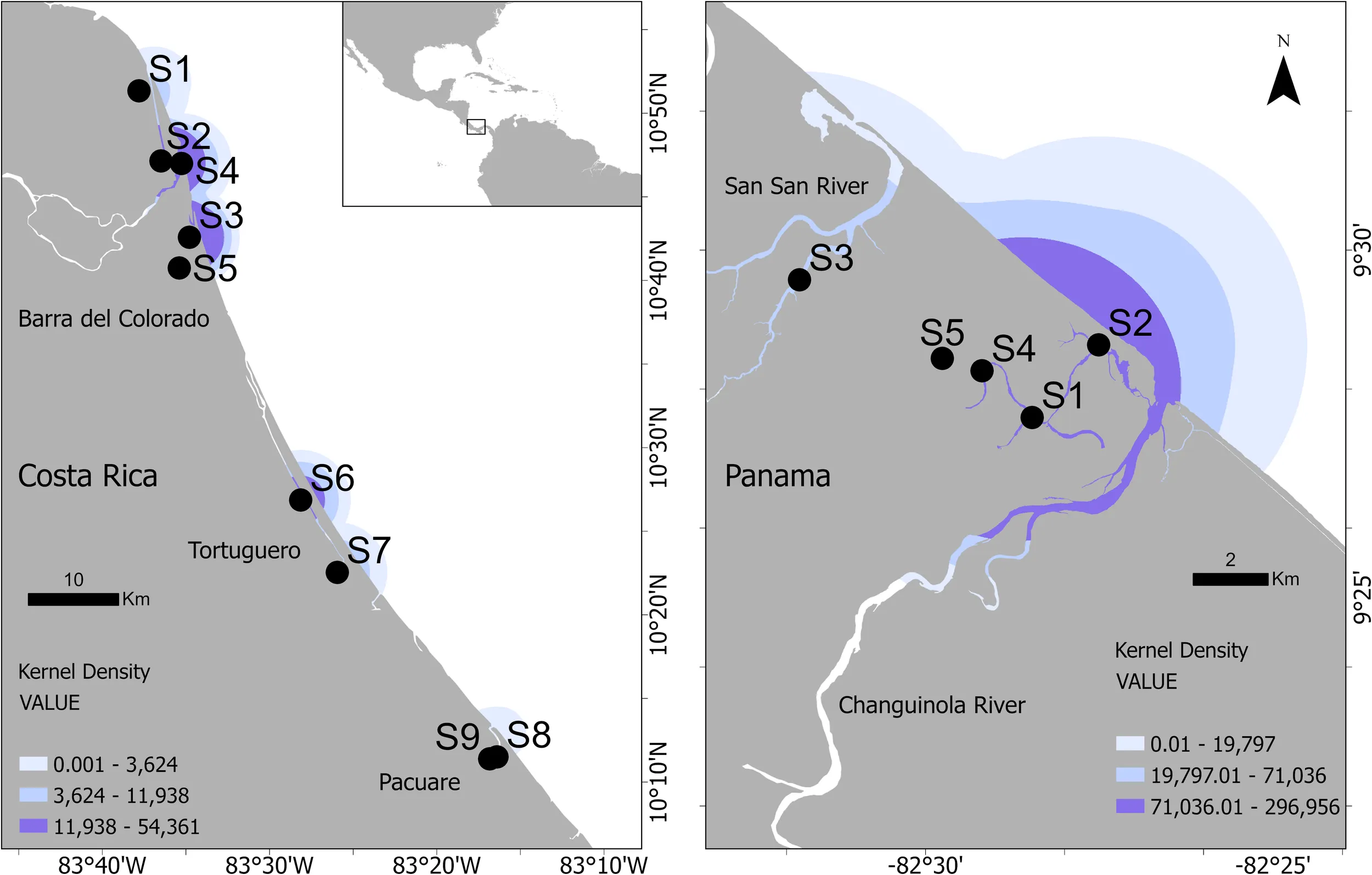
The ecology of the Greater Caribbean manatee (Trichechus manatus manatus) remains underexplored in southern Central America, particularly in Panama and Costa Rica. This study presents, for the first time, significant information about their local and regional movements, connectivity, and residence times in various wetlands. Since 2016, we have employed acoustic monitoring to track the manatee population, identifying individuals through their vocalizations. This method has been in use in Costa Rica since 2021. We identified 61 presumed individuals in Panama and 49 in Costa Rica, using calls that contained squeak, hi-squeak, and a combination of squeak and hi-squeak vocalizations. Their average residence time was 1,059 days in Panama and 292 days in Costa Rica, with some individuals remaining in the wetland complex for up to 3,026 and 1,160 days, respectively, occasionally venturing into the sea for short periods. Nine individuals exhibited regional movements, with an average of 340 days between detections in the two countries. The timing of this migration was analyzed using remote sensing data (air and sea temperatures, precipitation, and wave height) during the study period, which coincided with times of high rainfall and sea levels, as well as increased air and water temperatures. The observed connectivity and residence times suggest that manatees in this region of Central America rely on wetlands for both breeding and feeding. To support the long-term conservation of this area, we propose a binational corridor for manatees, approximately 984 km in length.
Journal: Frontiers in Marine Science